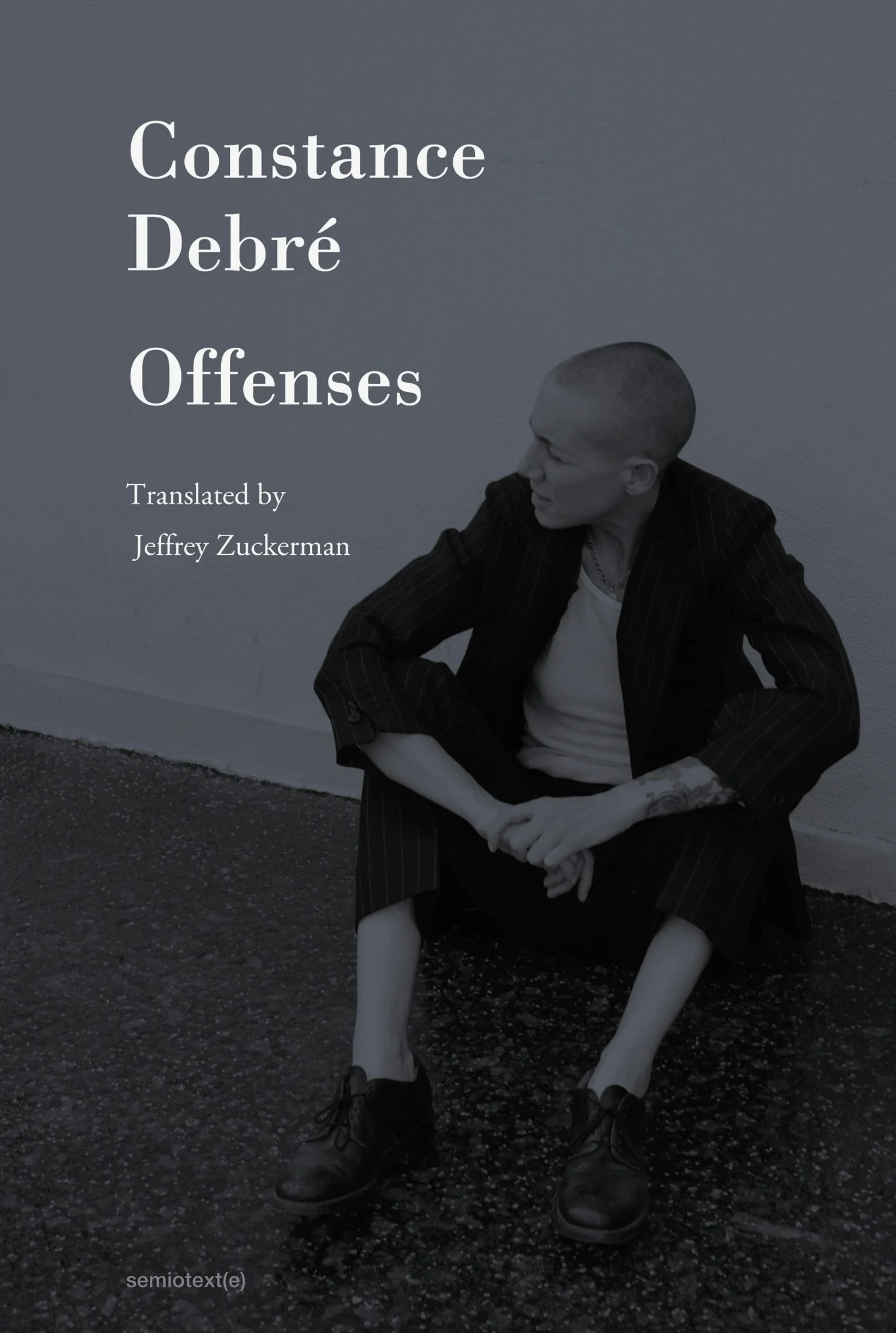
OFFENSES
Translated by Jeffrey Zuckerman
He is guilty, yes. He is guilty of having yielded, of not allowing himself to be crushed. He is guilty of not having been reasonable, of not having stayed in his place, the one that was his. To have disturbed the order of things …
Ten stab wounds. An old woman in a pool of blood. A nineteen-year-old neighbor now a murderer.
Since publishing her first novel in 2018, Constance Debré’s work has exposed the flaws in the social order with dizzying passion and intelligence. Her first-person trilogy—Playboy, Love Me Tender, and Name—describes the trajectory of leaving a comfortable bourgeois life as mother and wife employed as a criminal justice attorney to become a writer and lesbian. Her books radically challenge all received ideas of the couple, motherhood, family, and inheritance.
In Offenses, Debré trains her sights on a single case of inevitably flawed justice that, like hundreds of others like it, reveals the enmeshed culpabilities of the perpetrator, the victim, the place, and the past. In a housing project adjacent to Paris, an unemployed teenager kills his elderly neighbor in order to pay off a drug debt of €450. Writing with impassioned detachment, Debré uses forensic detail to explore the ambient senselessness behind this senseless crime.
There is a geography, Debré writes. We live in a vertical world, you don’t see. A world made of worlds. Not side by side but set concentrically and upon one another. A bit like Middle Age representations of the universe, a bit like Dante’s circles of hell. Each world only communicating with the worlds directly in contact with it and none of the others.
In Offenses, Debré scathingly describes the misery of poverty and the absence of any horizon beyond.
“Debré’s voice recalls that of someone like Henry Miller, cool but virile. Yet, unlike Miller’s, which at this point scans as cliché, Debre’s machismo subverts.”
—Gracie Hadland, Los Angeles Review of Books
“I find Debré's exquisite achievement not to reside in the realm of advice or guides for living. It’s in that cold sliver of voice, conducting electricity at a high voltage, sending the occasional shower of sparks off the page.”
—Christine Smallwood, Bookforum
“If Debré's novels were monotonously cynical or grim they would be far less pleasurable to read. They are brutal, but they are also something more—and that is very, very funny.”
—Anahid Nersessian, The New York Review of Books
Paperback, 96 pp.
Forthcoming March 24, 2026